
At his peak, Tekashi 6ix9ine's net worth is estimated to have reached somewhere between $8 million and $10 million, most likely in the 2018 to early 2019 window when his music was hitting streaming records, his touring schedule was packed, and brand attention was at its highest. That range isn't a confirmed balance-sheet figure because no such document is public. It's a reasoned estimate built from observable income signals, and this article walks through exactly how to read it, what drove it, and what eroded it fast.
6ix9ine Net Worth at Peak: Timeline, Income, and Legal Shifts

Marcus Rothstein
18 Apr 2026
What 'net worth at peak' actually means here
Net worth is a balance-sheet concept: total assets minus total liabilities at a specific point in time. For a private individual who hasn't filed a public financial disclosure, that number is never fully knowable from the outside. What estimation sites like CelebrityNetWorth, Wealthy Gorilla, and the newer Celebrity Worth Database do is reconstruct a plausible range using observable data points: streaming royalties that can be inferred from public chart and view data, reported deal values, documented legal judgments, and lifestyle spending signals. None of them have access to 6ix9ine's bank statements or tax returns, and they're upfront about that. Wealthy Gorilla explicitly labels its figures 'best estimates' and warns they shouldn't be treated as actual verified figures. That's the honest framing to carry through everything below.
For 6ix9ine specifically, 'peak net worth' points to a very narrow window: roughly mid-2018 through his arrest in November 2018. That's when all of his income streams were simultaneously active and before any of the major financial blows landed. The peak isn't a single date but a short plateau before a very steep decline.
Where the money actually came from

6ix9ine's wealth at his peak came from several converging streams, and understanding each one is the only way to make sense of the overall number.
Streaming royalties and YouTube revenue
His streaming numbers were genuinely enormous. 'Gummo' alone had 221 million on-demand video streams by the midpoint of 2018, according to Nielsen's U.S. midyear music report. His 'FEFE' collaboration with Nicki Minaj pulled 12.7 million YouTube views in a single day at its July 2018 peak. His Dummy Boy album closed out 2018 with over 1.5 billion on-demand streams total, with roughly 889 million of those being audio streams and 614 million video streams, per BuzzAngle Music's year-end data. His cumulative YouTube view count across his catalog has passed 8.78 billion total views per Kworb's tracking. At blended streaming payouts that typically run between $0.003 and $0.005 per stream on audio and significantly less per YouTube view after ad-revenue sharing, the royalty income from that 2018 period alone would realistically be in the range of several million dollars, depending on his royalty rate in his label deal and how catalog ownership was structured.
Touring and live performance fees

His 2018 World Domination tour included European dates starting in early July, with a Liege appearance at Los Ardentes documented as an early stop. At peak popularity with multiple charting singles, per-show fees for artists at his level typically ranged from $50,000 to $150,000 for festival slots and arena-level appearances. Detailed boxscore data showing attendance figures and gross revenue for each date isn't publicly available for his specific shows, which is a genuine gap in the estimate. What's clear from the public tour announcement and booking activity is that live performance was a material income source in 2018, likely contributing somewhere in the low-to-mid seven figures across the full year.
Record deal and advances
6ix9ine signed with 10K Projects and later had distribution arrangements that likely included upfront advances. Advances are not profit: they're recoupable against future royalties, which means they inflate the bank account in the short term but reduce future royalty income until they're earned back. This is a critical nuance in any hip-hop net worth estimate. An artist who received a $3 million advance but hasn't recouped it isn't $3 million richer in a true net worth sense, because that money is essentially a loan against earnings. His rapid streaming volume in 2018 suggests he likely recouped quickly, but the actual deal terms remain private.
Brand deals, endorsements, and social media

At his peak, 6ix9ine had one of the most-followed accounts in hip-hop and was using Instagram as an active promotional and business tool. Sponsored posts from artists at his follower level and engagement rate can command $50,000 to $200,000 per post in verified brand deals. There's no comprehensive public record of all his endorsements, but the volume of his social activity and cultural visibility in 2018 strongly suggests this was a non-trivial income line, even if it's the hardest one to estimate with precision.
The timeline: when the money moved
| Period | Key Event | Wealth Impact |
|---|---|---|
| Late 2017 | 'Gummo' release and viral explosion | Initial surge: streaming income begins, booking fees rise sharply |
| Early 2018 | Follow-up singles, label deal structure solidifies | Advances and royalty flow accelerate; net worth building |
| Mid-2018 | World Domination tour, 'FEFE' with Nicki Minaj drops July 2018 | Peak earning window: touring + massive streaming + brand interest converge |
| Late 2018 | Dummy Boy album release (Nov 2018), arrest (Nov 2018) | Album royalties begin flowing but arrest halts touring and deal activity |
| Early 2019 | Plea deal finalized (reported Feb 2019), prison sentence begins | Income streams largely frozen; legal costs rising |
| April 2020 | Released early from prison citing COVID-19 vulnerability | Partial return to activity but reputation and deal flow severely reduced |
| 2021 | ~$9.825M civil judgment filed against him | Forced asset sales; net worth enters deeply negative territory |
| 2025 | Additional 3-month prison sentence for supervised-release violations | Continued legal drag; recovery trajectory interrupted again |
The trajectory is unusually sharp in both directions. The rise from 'Gummo' in late 2017 to peak in mid-2018 is roughly 12 months of compounding income streams. The fall from arrest in November 2018 to a nine-figure civil judgment in 2021 is roughly 24 to 30 months. Very few artists have had a more compressed peak-to-trough cycle.
What ate the money: lifestyle and spending

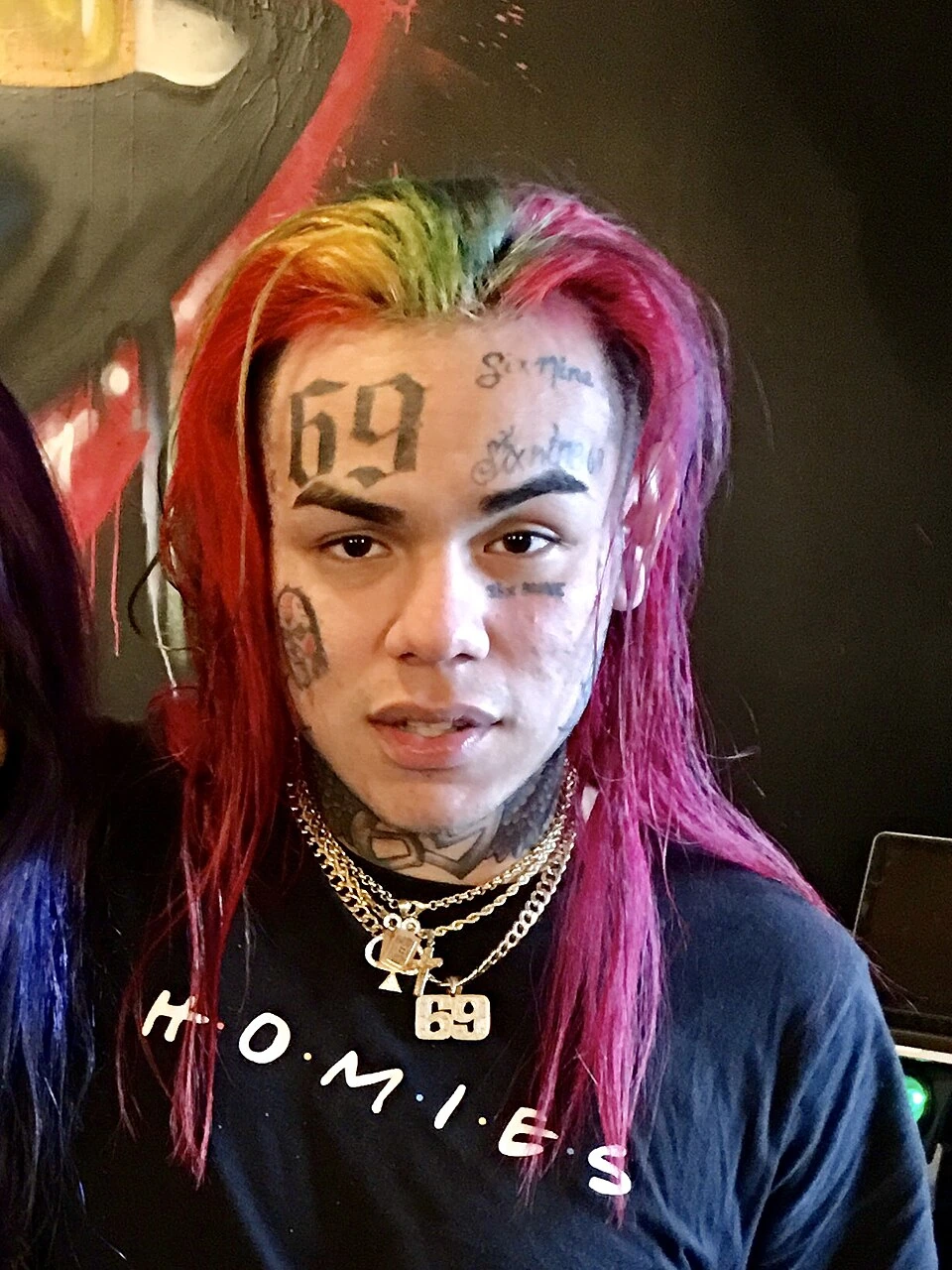
Even during peak earning, the outflows were significant. 6ix9ine's public persona was built on conspicuous display: rainbow hair, heavy jewelry, designer clothing, and a visibly large entourage. Entourage costs for artists at his level, covering travel, security, accommodation, and personal staff, can easily run $50,000 to $100,000 per month. High-end security is particularly expensive for an artist whose public profile invited physical threats, which was a documented reality for him well before his legal troubles.
The jewelry spending was also real and substantial. Custom chains and grills at the level he wore typically cost hundreds of thousands of dollars, and unlike real estate or financial instruments, they depreciate quickly and are difficult to liquidate at purchase price. These are expenses, not assets, in a meaningful net worth calculation. The net result is that even in his highest-earning months, the gap between gross income and net wealth accumulation was likely large. He was spending aggressively at the same time the money was coming in, which means the actual balance-sheet peak was lower than gross income figures alone would suggest.
Legal and financial events that hit the numbers hard
This is where 6ix9ine's financial story diverges most dramatically from other artists who simply spent too much. His legal exposure didn't just interrupt income. It actively removed assets and created liabilities that likely exceed any reasonable estimate of what he accumulated at peak.
- Federal forfeiture: As part of the federal racketeering case, AllHipHop reported on an order to forfeit cash connected to alleged drug-related proceeds. Civil and criminal forfeiture actions operate by seizing specific assets tied to criminal activity, which reduces net worth directly rather than just creating a payment obligation.
- Restitution order: Court documents referenced in the United States v. Hernandez appellate record include a $110,000 restitution order, illustrating that even after a plea deal the financial obligations continued to accumulate through the court process.
- Civil judgment of approximately $9.825 million: Complex reported in 2021 that 6ix9ine was forced to sell assets to cover a roughly $9.825 million judgment brought by a woman accusing him of assault at a Florida nightclub. Forced asset sales at distressed valuations rarely recover full market value, meaning the actual financial damage exceeds the judgment amount itself.
- Incarceration period (late 2018 through April 2020): Prison stops touring income, freezes recording activity, and causes labels and brands to pull back from deals. Even after his early release in April 2020, the practical earning capacity was a fraction of his 2018 peak.
- December 2025 sentencing: AP News reported a further 3-month prison sentence for supervised-release violations, showing the legal drag on his finances has continued well beyond the original case.
Taken together, these events almost certainly pushed 6ix9ine's net worth from a positive $8-10 million peak into negative territory by the early 2020s. That's not an unusual outcome when criminal forfeiture, a multimillion-dollar civil judgment, and legal fees all hit within a few years of peak earning. The plea deal reported by TMZ in February 2019 resolved some criminal exposure but opened up other financial and reputational liabilities that persisted long afterward. TMZ reports on February 17, 2019 that Tekashi 6ix9ine’s plea deal included a reduced sentence and witness-protection-related terms, which helps anchor the timeline of his federal case plea deal reported by TMZ in February 2019.
How to read and verify net worth estimates like this one
If you're trying to pressure-test a net worth figure you've seen for 6ix9ine or any other hip-hop artist, here's the methodology that produces the most defensible estimate.
- Start with observable streaming data. Platforms like Kworb track YouTube view counts at the song and artist level. Nielsen and BuzzAngle (now Luminate) publish periodic stream counts in their annual and midyear reports. These are real numbers you can use to infer royalty income, even if the exact per-stream rate depends on deal terms you don't have.
- Cross-check against publicly reported deal values. When label deals, tour guarantees, or endorsements are reported by trades like Billboard, Rolling Stone, or Variety, note the figures but treat them as gross, pre-recoupment numbers unless specified otherwise.
- Identify and subtract known liabilities. Court records, particularly federal dockets via PACER and civil case filings, often contain judgment amounts, forfeiture orders, and restitution figures. These are the most concrete negative inputs in any estimate.
- Apply a lifestyle discount to gross income. Artists who spend visibly at a high rate are almost always accumulating less wealth than their income would suggest. A rough rule of thumb is to assume 30-50% of gross artist income is absorbed by management fees (typically 15-20%), legal and accounting costs, entourage and travel, and lifestyle spending before any investment or savings.
- Use ranges, not single figures. Because deal terms are private and spending patterns are partially visible at best, honest estimates state a range. A figure like '$8-10 million at peak' is more credible than '$9 million' because it acknowledges the estimation uncertainty explicitly.
- Note the 'as of' date. Net worth is a point-in-time figure. A 2018 estimate and a 2024 estimate for the same artist can be radically different. Always anchor the figure to the specific period being discussed.
- Compare across multiple estimation sources, but weight them by methodology transparency. Sites that explain how they build their estimates and acknowledge limitations are more credible than those that present a single round number with no context.
For 6ix9ine specifically, the best available public inputs are the streaming figures from Nielsen and BuzzAngle for 2018, the reported civil judgment from Complex, the forfeiture reporting from AllHipHop, and the court-record references to the restitution order. These give you anchor points on both sides of the ledger. What you can't reconstruct from public data alone is the precise label deal structure, the total legal fees paid, or any private investments. That's the irreducible uncertainty in any estimate.
Where this leaves the peak number
The most defensible read is that 6ix9ine reached peak net worth of roughly $8 million to $10 million in mid-2018, driven primarily by streaming royalties from an extraordinary volume of on-demand streams, live performance fees from his World Domination tour and other appearances, and likely a combination of label advances and brand income. That peak was brief, probably less than 12 months at its highest point, and it was followed by one of the more severe financial collapses in recent hip-hop history: a combination of criminal forfeiture, a nearly $10 million civil judgment, incarceration interrupting income, and continued legal costs through 2025. If you're looking for where his net worth stands now rather than at peak, that's a materially different and likely much lower figure, and one worth examining separately given how much changed between 2018 and today. To understand 6ix9ine net worth now, you need to look at what those forfeiture and judgment payments did to his assets after the peak.
FAQ
Why do different websites show different “peak net worth” numbers for 6ix9ine?
No. “Net worth at peak” in these estimates is a modeled range, not a verified balance sheet. The peak can also shift depending on whether you treat advances as equity (some calculators do) or as recoupable liabilities (more accurate), which can move the midpoint of the range by millions.
How should I interpret label advances in a net worth estimate?
A more defensible approach is to separate gross cash flow from balance-sheet value. Advances, even large ones, are typically recoupable against future royalties, so they can look like wealth in a single month while not increasing true net worth until recoupment is completed.
How do streaming royalties differ based on deal structure and catalog ownership?
Check whether the number assumes catalog ownership. Royalties depend heavily on who owns the masters and publishing rights. Two artists with identical stream counts can have very different royalty totals if one sells or licenses rights and the other retains ownership.
Why can tour-related money inflate net worth estimates?
Tour gross is not the same as take-home. Your estimate should account for promoters, venue splits, production costs, travel, security, and management fees. If you see a figure based only on attendance or advertised tour revenue, it will usually overstate net worth.
If his streams peaked in 2018, why might net worth peak occur later or earlier?
Because streaming payout timing matters. Even with huge stream counts in 2018, royalties are paid on delayed cycles and can be reduced by recoupment, chargebacks, or contractual holds, so the highest bank balance might lag behind the highest streaming month.
What legal events most directly created liabilities that hurt net worth after the peak?
The sharp drop suggests obligations that persist beyond arrest, not just lost income. Civil judgments and restitution orders can create liens, garnishment, and legal costs, which reduce assets and increase liabilities even if an artist had occasional revenue afterward.
How can I tell whether a posted number is his peak or his current net worth?
Yes, if you see a number described as “current” without a timeline. A net worth snapshot can be dramatically lower by 2021 to 2025 due to judgments, forfeiture, and ongoing legal fees, so always verify that the figure is labeled “at peak” versus “now.”
Can new releases or appearances after 2018 increase his net worth despite legal pressure?
Be cautious with post-2019 “income” narratives that ignore what portion was paid to recoup debts or satisfy court orders. In high-liability cases, new revenue may not accumulate as new net worth because it is immediately offset by obligations.
Why is it hard to estimate Instagram and brand deal income for him?
Social media sponsorship ranges are wide, and the reliable signal is not follower count alone, but engagement rate, brand safety, and the ability to deliver audiences consistently. Also, some contracts include performance fees or brand-delivery terms that make actual realized earnings lower than headline estimates.
Why do flashy purchases not necessarily mean higher net worth?
Many estimates miss asset liquidity. Jewelry, clothes, and luxury items often depreciate and are hard to sell at purchase price, while debts can be demanded immediately. So “spending” can raise cash outflow without adding lasting net worth.